
HPE’s $2.9 Billion Networking Quarter: Juniper Stops Being an Acquisition and Starts Being a Business

HPE reported fiscal third-quarter results this afternoon: record revenue of $12.2 billion, up 34% year over year, non-GAAP EPS of $1.11 against a guide of $0.88 to $0.93, and raised outlooks for both FY26 and FY27. Antonio Neri called AI “a multi-year growth driver.” Every outlet will write that story tonight, so I am going to spend this piece somewhere else: on the $2.9 billion networking business HPE assembled out of Juniper, and on what the market underneath it is actually doing.
The segment I care about is the one HPE built through the Juniper Networks acquisition, because this is the quarter where its story changed. For four consecutive quarters, HPE Networking’s growth rate has been an accounting artifact, a Juniper-sized business layered onto an Aruba-sized base. That artifact ends now. Q3 FY26 is the last quarter with an asymmetric comparison, because the prior-year period contained roughly one month of Juniper, and the outlook HPE gave today tells us what this business looks like once the acquisition math falls away.
The short version: it looks like a $3 billion-a-quarter networking company growing organically in the low double digits at a 22% operating margin, with routing and AI data center switching as the two swing factors. That is a different competitive animal than the Aruba of two years ago, and the industry should treat it that way.
The headline: $2.9 billion, up 75%, at a 22% margin
Networking revenue was $2.893 billion, up 74.9% year over year. Operating margin was 22.0%, essentially flat against 22.1% a year ago and up from 21.6% last quarter. Every one of the four reported sub-segments grew: Campus & Branch reached $1.4 billion (up 31.0%), Routing reached $788 million (up 270.0%), Data Center Networking reached $382 million (up 112.2%), and Security reached $281 million (up 75.6%).
The year-over-year rate is the number that will be quoted, but it is the least informative one on the page. The prior-year quarter contained one month of Juniper, so the 75% is mostly Juniper being present for three months instead of one. The more useful read is sequential. Networking had been flat at roughly $2.7 billion for three straight quarters (Q4 FY25, Q1 FY26, Q2 FY26); Q3 broke that plateau with a 7% sequential step-up to a new record. After two quarters of “the business is stable,” this was the first quarter of “the business is growing,” and that shift is the reason HPE raised its FY26 networking growth outlook to 73% to 74% from the 68% to 73% range it gave back in March.
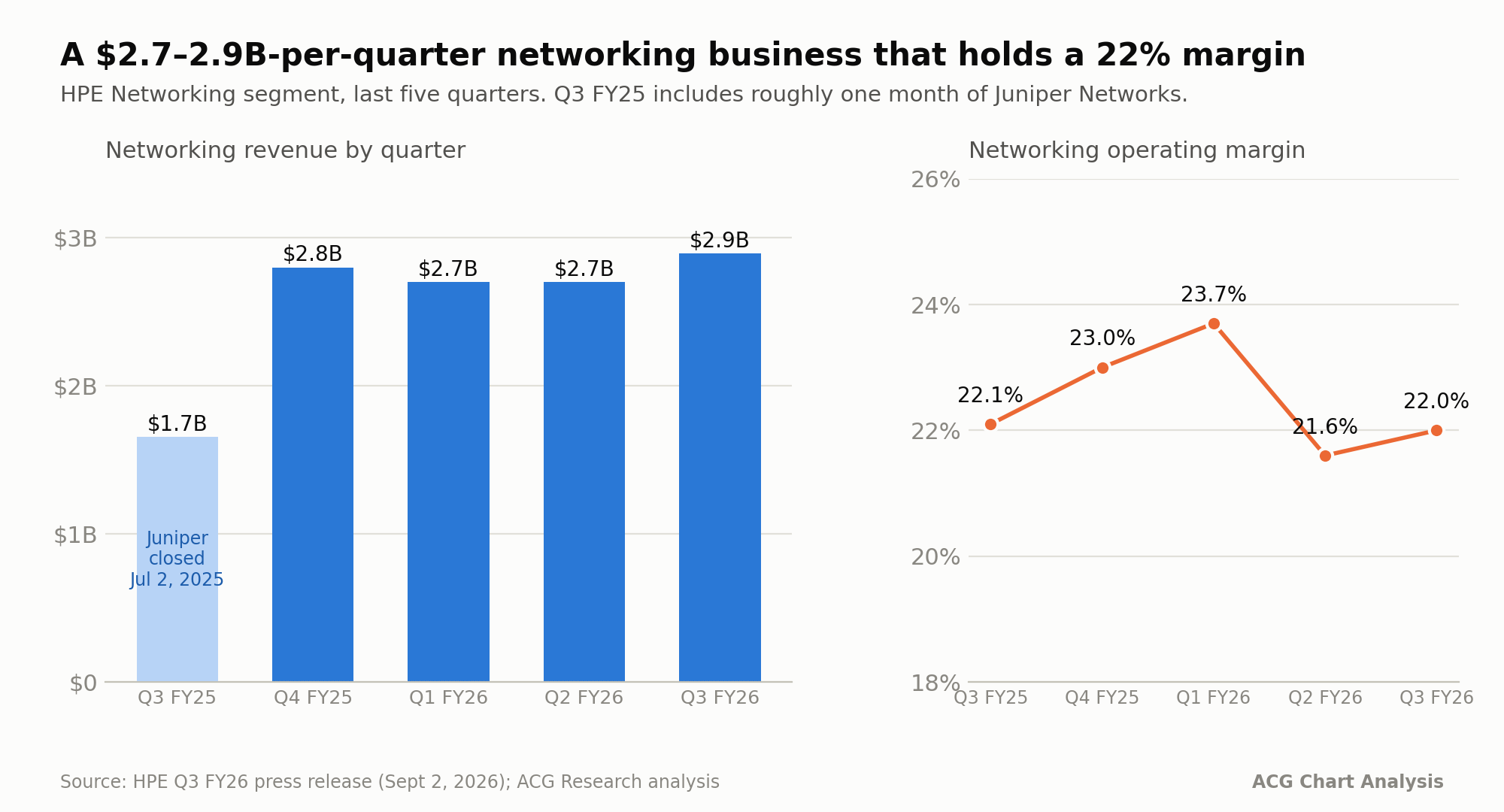
ACG Chart Analysis. The left panel is the story of the last five quarters in one picture: Juniper closed on July 2, 2025, the segment stepped to $2.8 billion in the first full quarter, then sat there for two more before Q3 broke higher. The right panel is what I would watch more closely than revenue. Margin peaked at 23.7% in Q1, dropped to 21.6% in Q2 as cloud-provider routing and data center mix rose, and recovered to 22.0% this quarter on higher volume. HPE has told investors it expects networking margins to reach the mid-to-high 20s under its FY27 framework. The Q3 print says that path runs through operating leverage and synergy capture, not through mix, because the fastest-growing pieces of this portfolio are the lower-margin ones.
What actually drove the growth
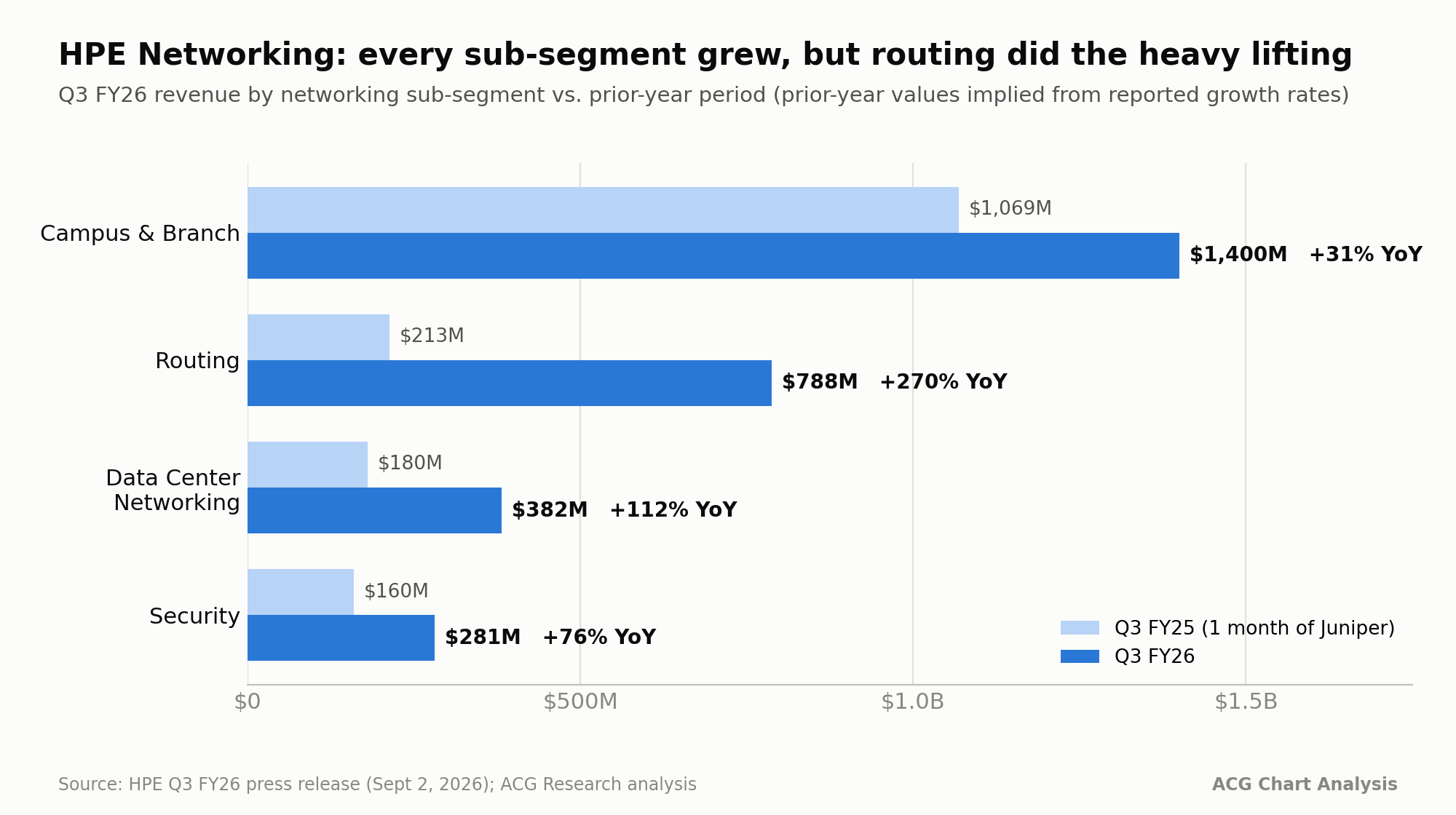
ACG Chart Analysis. The light bars are the implied prior-year values (I backed them out of HPE’s reported growth rates), and they make the composition of the growth obvious. Of the roughly $1.24 billion in year-over-year networking growth, routing contributed about $575 million, campus and branch about $330 million, data center networking about $200 million, and security about $120 million. Routing is 27% of the segment’s revenue but delivered close to half of its growth. That is the Juniper effect in its purest form.
What is driving this market, and why I read it as structural
Before going sub-segment by sub-segment, it is worth naming the forces moving networking budgets right now, because HPE’s numbers only make sense against them. I see four, and this portfolio touches all four.
First, AI has split “the network” into three separate buying centers, and the industry keeps discussing it as one. There is the back-end fabric that stitches accelerators together inside a cluster, where Nvidia’s Spectrum-X, Arista, and Broadcom-based systems dominate the conversation. There is the front-end fabric connecting those clusters to storage, to the rest of the estate, and to users. And there is the wide-area and data center interconnect layer, the routing that has to expand every time an operator lights a new site, links two regions for distributed training, or pushes inference toward the edge. Those three pools buy on different cycles, out of different budgets, and frequently from different vendors. HPE is a challenger in the first, credible in the second, and genuinely strong in the third. Hold that split in mind and this quarter stops looking lopsided: routing enormous, data center networking small but doubling, is precisely the shape you would predict.
Second, cloud and AI capital spending reaches routing before it reaches fabric. The sequence of a build is land, power, transport, then compute. Operators commit backbone and interconnect capacity ahead of the racks that will fill it, which is why a routing business can run hot for several quarters while data center switching stays lumpy. Anyone reading HPE’s routing line as a proxy for AI cluster wins is reading it wrong. It is a proxy for how much capacity the cloud and service provider community is committing to build, and on that measure the commitment is not slowing.
Third, the campus refresh is real, and AI operations is what is unlocking the budget. Wi-Fi 6 and 6E estates deployed between 2020 and 2022 are aging into replacement, and Wi-Fi 7 is the nominal trigger. But the reason finance is approving these projects is operational rather than radio: network teams have not grown, estates have gotten more complex, and a platform that measurably cuts incident volume pays for itself in headcount avoided. That is why the Mist and Aruba Central story matters more than any access point spec sheet, and why I expect this cycle to run into FY28 rather than exhaust itself next year.
Fourth, enterprises are actively cutting the number of networking vendors they carry. Nearly every large buyer I talk to is trying to reduce the count of consoles, contracts, and support relationships, and that dynamic rewards whoever can credibly sell the whole stack. This, not product overlap, is the strategic core of the Juniper deal. The overlap was always modest. The real prize was the ability to walk into a renewal conversation with wireless, wired, WAN, security, and now service provider routing on one piece of paper.
Those four forces are why I read this quarter as structural rather than cyclical. With that as the backdrop, the sub-segments start telling a clearer story.
Routing: the service-provider and cloud business HPE never had
Routing is the sub-segment that did not exist at HPE before Juniper, which is why the reported growth rate of 270% (and the “$1 million prior year” figures HPE has shown in earlier quarters) tells you little. What matters is that the business has now posted three consecutive quarters at $775 million to $788 million, which is a roughly $3.1 billion annual run-rate. That is a real, scaled routing franchise built on Juniper’s PTX and MX platforms, and it is the piece of the portfolio with the most direct exposure to hyperscale and cloud-provider capital spending.
The industry context here is important. When people talk about “AI networking,” they usually mean the back-end fabric inside a cluster. That is a switching conversation, and it is where Nvidia, Arista, Broadcom-based white boxes, and Cisco fight. Routing sits at a different layer: the data center interconnect and wide-area backbone that has to grow every time a cloud provider adds a campus, links two regions for distributed training, or pushes inference traffic to the edge. HPE has started calling this “scale-across” to distinguish it from scale-up and scale-out, and while the branding is marketing, the underlying demand is not. On the Q2 call, management said routing orders rose nearly 30% driven by cloud service provider deployments, with the 800-gigabit PTX platform the anchor product. A steady $780 million a quarter with orders growing faster than revenue is the profile of a business that is filling backlog rather than harvesting it.
The strategic point for the industry: the Juniper deal was sold to regulators and investors as a campus-and-enterprise story, but a quarter of the combined networking segment is now carrier-and-cloud routing, and it is the sub-segment carrying the most growth. HPE is now a participant in a market it was not in eighteen months ago, competing directly with Cisco and Nokia for backbone and DCI budgets at the largest network operators in the world. That has consequences for Nokia in particular, which had positioned its IP routing business as the alternative to Cisco for cloud providers.
Campus & Branch: half the business, and it is not slowing
Campus and branch is the largest sub-segment at $1.4 billion, and it grew 31% year over year and about 8% sequentially. Growth here is less distorted by the acquisition than routing (Aruba was already a scaled campus business), so a 31% rate that has been stepping down from 42% in Q1 and 50% in Q2 is exactly what you would expect as the Juniper Mist contribution laps itself. The sequential growth is the real signal, and it is healthy.
Three things are driving it, in my view. First, the Wi-Fi 7 refresh is real and it is broad. HPE said in Q2 that Wi-Fi 7 access point sales were up more than seven-fold, and campus and branch orders were at a record high. Enterprise wireless refreshes tend to run three to four years and this one is early, which matters for the FY27 outlook. Second, the combined Aruba Central plus Mist AI story is landing with large customers. The Lowe’s win HPE highlighted last quarter, combining the campus portfolio with Mist AI and EdgeConnect SD-WAN, is the kind of full-stack branch deal that neither Aruba nor Juniper could have credibly won alone against Cisco. Third, HPE’s “self-driving network” positioning, which sounded like a slogan when the deal closed, now has customer proof points behind it (the UK Ministry of Justice’s roughly 75% reduction in network incidents is the one HPE keeps citing).
The competitive implication is that Cisco now faces a campus competitor with two of the industry’s three leading cloud-managed platforms under one roof, a 20-time Gartner Magic Quadrant leader in wireless LAN, and a sales force that is no longer split. Cisco’s own campus refresh is strong, so this is not a share-shift story yet. But it is the first time in a long time that the enterprise campus market has a credible number two with the scale to invest at Cisco’s pace.
Data Center Networking: small, lumpy, and the most important line to watch
Data center networking revenue was $382 million, up 112% year over year and up 19% sequentially from a soft $320 million in Q2. It is the smallest hardware sub-segment and the most volatile: $444 million in Q1, $320 million in Q2, $382 million in Q3. That pattern is typical of a business with growing exposure to a handful of large AI cluster deployments, where a single project slipping a quarter moves the number by 20%.
This is where HPE’s AI networking ambitions actually live, and it is worth being precise about what the company is and is not. HPE has raised its cumulative FY26 “networks for AI” order target to at least $2 billion. It is positioning across all three dimensions of AI fabric: scale-out with the Juniper QFX fabric and a Tomahawk 6-based, fully liquid-cooled switch it claims to be first to productize as an OEM; scale-up with an Ethernet switch being built for AMD’s Helios rack-scale architecture, expected this fall; and scale-across with PTX routing. That is a coherent portfolio, and the AMD Helios attachment in particular gives HPE a scale-up Ethernet story at the moment the industry is debating whether Ethernet can displace proprietary scale-up interconnects.
What HPE is not, yet, is a large data center switching vendor. At a roughly $1.5 billion annual run-rate, data center networking is a fraction of Arista’s business and a fraction of Cisco’s, and Nvidia’s Spectrum-X has become the default Ethernet fabric attached to Nvidia GPU clusters. HPE’s advantage is different from those vendors’: it sells the servers, the storage, the liquid cooling, and now the fabric as a single system, and its 112% growth suggests that bundling is working in enterprise and sovereign AI deals where the customer wants one throat to choke. The question for FY27 is whether that pull-through extends into the cloud-provider deals where the fabric is specified separately. The 19% sequential rebound is encouraging; the Q1-to-Q2 drop is a reminder that this line will not move in a straight line.
Security: the sleeper
Security reached $281 million, up 76% and up about 3% sequentially. It is the smallest sub-segment, but it is the one with the clearest strategic logic: HPE now owns Juniper’s SRX firewall line, the Axis-derived SASE stack, and Aruba’s ClearPass NAC, and it launched the SRX 400 series for branch environments this year. Security is where the campus, branch, and SD-WAN pieces converge into a recurring-revenue attach, and it is the sub-segment most likely to lift segment margin over time. Mid-teens normalized order growth in Q2 says it is being sold, not just bundled.
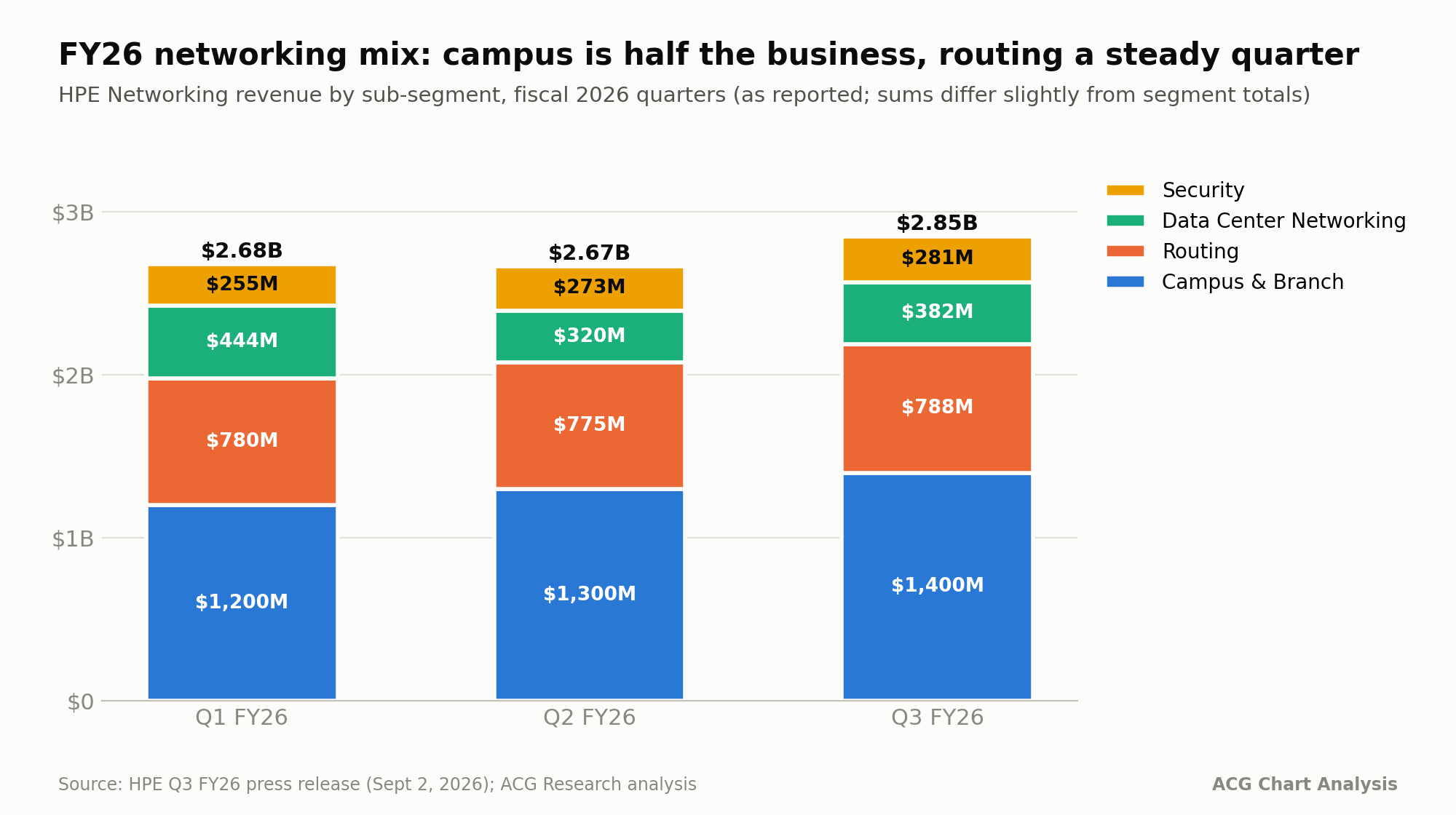
ACG Chart Analysis. The mix has been remarkably stable across the three FY26 quarters: campus and branch at roughly half, routing at roughly 27%, data center networking at 12% to 16%, and security at around 10%. The stability is itself the insight. Growth in Q3 came from campus and data center networking stepping up together, not from one sub-segment carrying the others. Note that the sub-segment sums run a few percent below the reported segment total because HPE rounds campus and branch to the nearest $100 million; I have plotted the reported figures rather than forcing them to reconcile.
Why the 22% margin matters more than the 75% growth
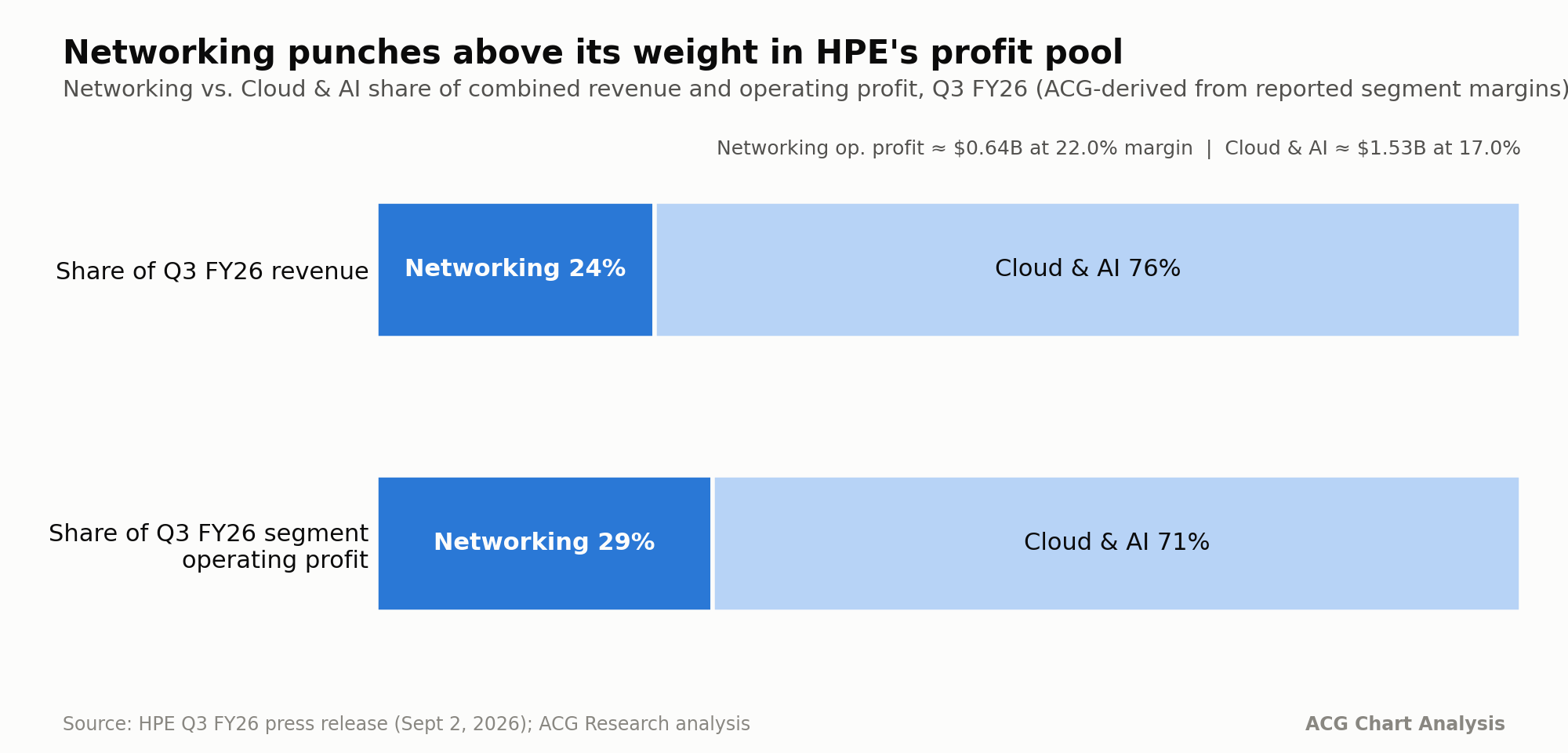
ACG Chart Analysis. Networking was 24% of HPE’s Q3 revenue and, applying the reported 22.0% and 17.0% segment margins, roughly 29% of the combined operating profit of the two main segments. A year ago the gap was much wider (Cloud & AI ran at 7.0% then, and now runs at 17.0% on the AI server ramp), so networking’s share of profit has actually declined as the server business recovered. That is a good problem, but it makes the point that networking is HPE’s structural margin business, and the one with the least exposure to GPU pass-through economics. Its 22% is a floor with visible upside from synergies; Cloud & AI’s 17% is a strong quarter that depends on AI systems mix.
The Q3 margin performance also tells us something about integration. HPE said in June that it would exceed its $200 million annual Juniper synergy target by the end of this fiscal year, ahead of a three-year target of at least $600 million, and that R&D optimization and supply chain consolidation were the next levers. Holding a 22% margin while growing routing and data center networking (both structurally lower-margin than campus wireless) is evidence that the synergy capture is real and is being reinvested rather than simply dropping through. That is the right choice for a business trying to establish itself in AI fabric.
The outlook: reading the Q4 comp
Here is the part of the release that I think deserves the most attention, and it takes a bit of arithmetic. HPE raised its FY26 networking growth outlook to 73% to 74%. FY25 networking revenue, reconstructing the quarters from HPE’s own growth disclosures, was roughly $6.6 billion. Seventy-three to 74% growth on that base implies FY26 networking revenue of about $11.4 to $11.5 billion. Through three quarters HPE has reported roughly $8.3 billion. The implied fourth quarter, allowing for rounding in the quarterly figures, is somewhere around $3.2 billion.
Two things fall out of that number. First, it would be HPE’s first $3 billion networking quarter, a sequential step-up of roughly 10% on top of the 7% delivered in Q3. Second, and more important for anyone tracking the market, Q4 FY25 was the first full quarter of Juniper, at $2.8 billion. So the Q4 FY26 comparison is the first clean, like-for-like Juniper comp, and the guidance implies year-over-year networking growth in the low-to-mid teens. That is the organic growth rate of the combined company, and it is the number the industry should carry forward, not the 75%.
A low-to-mid teens organic rate for a $12 billion networking business would put HPE among the fastest-growing scaled networking vendors in the market, behind the AI fabric pure plays but well ahead of the broader enterprise networking market, which I would put in the mid-to-high single digits for calendar 2026. The FY27 framework HPE raised today (13% to 17% company revenue growth, 14% to 15% non-GAAP operating margin) does not break out networking, but given that the company has already told investors to expect networking margins in the mid-to-high 20s over that horizon, the framework implies networking grows at least in line with the company and does so at rising profitability.
What I am watching from here
The routing run-rate is the first thing. Three quarters at $775 to $788 million looks like backlog conversion at a steady pace; if orders are growing close to 30% as HPE said last quarter, revenue should eventually step up, and if it does not, the question becomes whether cloud-provider routing demand is being deferred to other vendors or to white-box alternatives. Data center networking is the second, because it is the sub-segment that determines whether HPE is an AI fabric vendor or an AI systems vendor that also sells switches. Two consecutive quarters above $400 million would settle that argument. The third is the margin path: the FY27 framework needs networking to move from 22% toward the mid-to-high 20s, and the only way to get there while routing and data center networking outgrow campus is through the synergy program and software attach (Mist, Central, SASE) rather than through mix.
The broader industry takeaway is that the Juniper acquisition has moved out of the integration phase faster than most of us expected. Fourteen months after close, HPE has a networking business with a stable mix, a margin holding at 22%, growth re-accelerating sequentially, a raised full-year outlook, and a guide that implies double-digit organic growth against its first clean comp. Cisco still sets the pace in enterprise networking and Arista and Nvidia still set it in AI fabric, but there is now a third scaled vendor with a full portfolio, from the wireless access point to the 800-gigabit core router, and the balance sheet to keep investing in it. That was the thesis of the deal. Q3 FY26 is the first quarter where the numbers support it without an asterisk.
A note on sources: this analysis is based on HPE’s Q3 FY26 press release issued today and on the company’s disclosures and earnings-call commentary from the prior three quarters. The Q3 FY26 call transcript was not available at the time of writing; I will update the view if management’s commentary on networking orders and backlog changes the picture.
Sources: HPE Q3 FY26 press release · HPE Q2 FY26 press release · HPE Q2 FY26 earnings call transcript · HPE Q1 FY26 press release · HPE Q4 FY25 press release · Constellation Research on HPE Q3 FY25
Disclosure: I am an industry analyst, not a financial analyst, and this is not investment advice. Nothing here is a recommendation to buy, sell, or hold any security. This is an industry analyst going deep on the networking portion of the HPE and Juniper business, written for the people who build, buy, and compete in networking.
Originally published on Ray Mota's Substack. Subscribe to get new analysis by email.